









Global Affairs Policy

Summary
The Green Party supports an international rules-based order that protects and restores the environment, upholds fundamental human rights and international justice, and acts in unison in a responsible and non-violent manner to support peace globally.
OUR VISION
Aotearoa New Zealand takes independent, principled stances on the global stage to cooperatively uphold the rights and interests of all and our planet, now and in the future.
Values and Principles
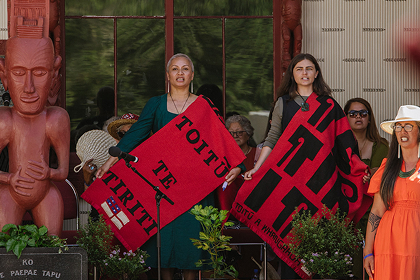
Honour Te Tiriti o Waitangi:
Aotearoa New Zealand’s global relations should uphold the articles of Te Tiriti and support all indigenous peoples and their global movements, including movements to return land dispossessed by colonisation.
Ecological Wisdom:
The global ecological foundations that sustain life must be urgently protected and restored and be at the heart of our relations with the rest of the world.
Social Responsibility:
Global equity and justice are foundations for the security, prosperity, and resilience of all countries. The international system must act collectively to meet the diverse needs of communities, while advancing the common interests of people everywhere. While all countries share a common obligation to address global challenges, their responsibilities differ based on their historical contribution and capacity to act.
Appropriate Decision-Making:
International rule of law, and fair, impartial and transparent national and international institutions based in law, are key mechanisms to address global challenges. The self-determination of peoples is an essential step in the attainment of universal peace.
Non-Violence:
A world without violence is possible. Meaningful, rapid cooperation among all states and other international communities is required to peacefully and successfully resolve conflicts and global challenges.
Complexity:
The interconnected nature of global challenges and their systemic causes requires a sustained, dynamic approach that includes overseas and international organisations.
Integrity:
Criticism of any foreign state or overseas organisation by Aotearoa New Zealand for violation of these principles should never be muted in the name of narrow economic or political interests, or historic affiliations.
Strategic Priorities
- Working cooperatively, generously, and respectfully with other countries to address global challenges, taking an enabling approach to support countries that have less capability to contribute to solving global problems (3.1)
-
Advocating for international cooperation and coordination on:
- Strengthening international agreements for managing, restoring, and enhancing the ecological health of the global commons, including climate, high seas, air, and globally significant ecological assets, including biodiversity (1.1.1)
- Establishing Ecocide as a crime under the Rome Statute of the International Criminal Court (1.1.2)
-
- Coordinating rapid international phase-out of practices and substances that threaten the ongoing viability of humanity and other species (...) (1.1.3)
- Pursuing conflict prevention and peaceful resolution of international conflict, including diplomatic efforts to address conflicts before they escalate and facilitating peace mediation between states and/or non-state actors (2.5.1)
- New international agreements that protect the rights of as yet unprotected marginalised groups (2.1.2)
- Cancelling unjust debt and providing unconditional debt relief that alleviates global inequality (3.1.3)
Connected Policies
Connected internationally-oriented policies outline our approach to appropriate and ethical Trade and Foreign Investment, non-violent Security and Defence, and compassionate Immigration. Several other policies support the domestic implementation of international agreements, including those related to Climate Change, Biodiversity and Environmental Regeneration, the Marine environment, Human Rights, Animal Welfare, Digital technologies, and Education.