








Biodiversity and Environmental Regeneration Policy

Summary
In Government, the Green Party will take a holistic approach to conservation. We will make sure Aotearoa New Zealand plays a leading part in protecting the biodiversity of planet Earth from the global mass extinction that is currently underway. We will protect threatened indigenous species from invasive species, diseases, and human activity, and support the kaitiaki role and indigenous knowledge of tangata whenua.
OUR VISION
Indigenous biodiversity thrives and there is a healthy relationship between people and te taiao | the environment.
Values and Principles
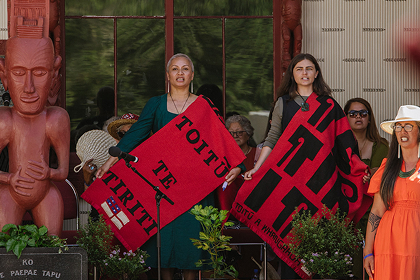
Honour Te Tiriti o Waitangi:
Regenerative efforts must recognise the kaitiaki role of tangata whenua and the insight that mātauranga Māori brings.
Ecological Wisdom:
Regenerative efforts must recognise the inherent value of nature, and work within its complex dynamics. We must actively safeguard and regenerate indigenous ecosystems, Ki uta ki tai | from the mountains to the sea.
Social Responsibility:
Regenerative efforts must ensure future generations will inherit a healthy environment, which is achieved alongside progress on social issues.
Non-Violence:
Regenerative efforts must cause minimal harm whilst preventing the harm caused by inaction.
Appropriate Decision-Making:
Regenerative efforts must be adaptable, evidence-based, and effective. Decision-making must be distributed equitably, engage with local communities, and achieve co-benefits.
Interconnectedness:
Regenerative efforts must recognise that humans are interdependent with other species. Our survival requires a functional biosphere as we are part of the circle of life and share a common descent and whakapapa.
Strategic Priorities
- Establishing a job guarantee programme focused on understanding, protecting, and regenerating ecosystems. (2.1.1)
- Broadening legal protections and conservation strategies to cover indigenous fish, plants, invertebrates, and fungi to recognise the importance of taxonomic diversity. (3.1.2)
- Investigating appropriate regulation that limits or suspends the harvesting of vulnerable aquatic species, such as whitebait, to ensure populations regenerate. (3.1.3)
- Significantly increasing resourcing for bodies that eradicate and control invasive species and weeds, prioritising the eradication of invasive species identified in Predator Free 2050 and other species with disproportionate effects on indigenous ecosystems. (3.2.3)
- Taking a collaborative, Tiriti-based approach to Government-led conservation, such as co-governance and co-management (4.2.3)
- Establishing a Sovereign Biodiversity Fund to resource regenerative efforts. (2.1.3)
Connected Policies
See also our specific policies for the protection and regeneration of Land, Freshwater, and Marine ecosystems, and our policies relating to:
- Establishing legal rights of nature and recognising the legal status of Papatūānuku (Governance Policy) and a right to a healthy environment (Human Rights Policy)
- Ensuring economic activities uphold the wellbeing of the natural world (Government in the Economy, Business, and specific sectors, e.g. Agriculture, Tourism, Forestry)
- Minimising the further loss of indigenous ecosystems to other land uses (Land Use and Soils Policy)
- Adapting urban design to support environmental growth (Housing and Sustainable Communities Policy)
- Collaborating with other countries, including strengthening international treaties (Global Affairs Policy) and leveraging trade agreements (Trade and Foreign Investment Policy)
- Aligning ‘carbon farming’ with ecological resilience (Climate Change Policy)